A sale deed registration Tamil Nadu is the registered legal document that finally transfers ownership of a property from seller to buyer without it, even a fully paid-for property does not legally belong to you. This guide explains what a sale deed is, how it differs from a sale agreement and a gift deed, current 2026 stamp duty rates, required documents, and the complete TNREGINET registration process.
Final Ownership Transfer
7% + 4% = 11% Charges
Registration Mandatory
2026 Updated Rates
What is a Sale Deed in Tamil Nadu?
A sale deed, also called a conveyance deed, is the legal document that records the actual transfer of ownership from a seller to a buyer in exchange for an agreed sale value. It is executed once all terms in the sale agreement are fulfilled, and is the final step of the property registration process that makes the buyer the absolute legal owner. Under the Registration Act, 1908, a sale deed for immovable property has no legal effect until it is registered at the Sub-Registrar Office (SRO) having jurisdiction over the property’s location.
Many first-time buyers confuse the sale deed with the sale agreement signed earlier in the process. They are not the same document, and the difference matters before you begin sale deed registration.
Sale Deed vs Sale Agreement vs Gift Deed: What’s the Difference?
These three documents often get mixed up because all three relate to property changing hands, but each is registered at a different stage and at a very different cost.
⚡ Key takeaway: Signing a sale agreement does not transfer ownership only a registered sale deed does. If you’ve already paid the full amount but only hold a sale agreement, your purchase is legally incomplete until sale deed registration is done at the SRO. If the transfer instead involves no payment between family members, you may need a Settlement Deed or Release Deed instead. Check the exact applicable amount on the Stamp Duty Calculator before you proceed.
Stamp Duty and Registration Fee for Sale Deed Registration in Tamil Nadu (2026)
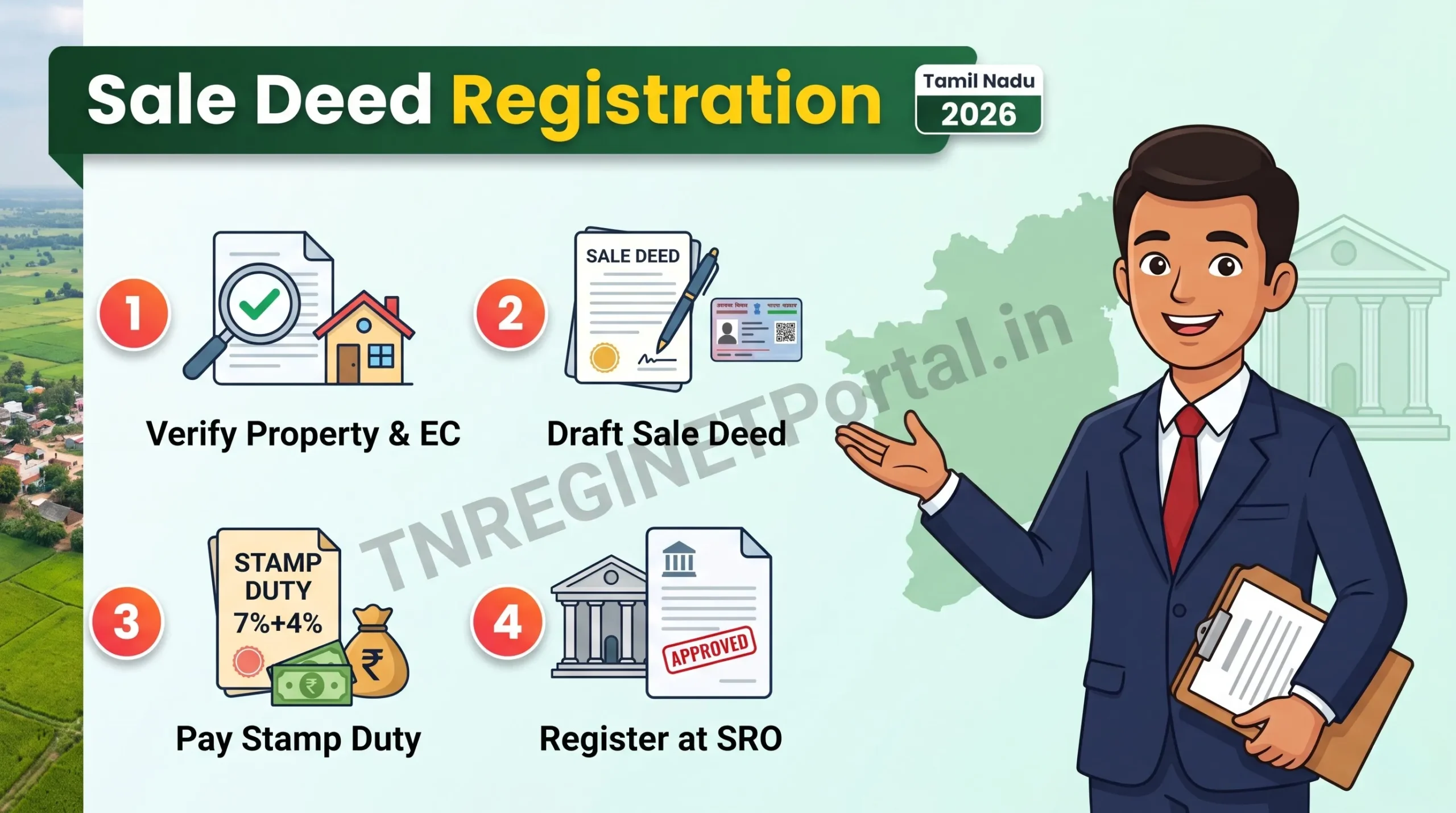
Per the Inspector General of Registration’s published fee schedule, conveyance (sale) transactions attract a flat combined rate regardless of city the same percentage applies whether you’re registering in Chennai, Coimbatore, Madurai, or anywhere else in the state.
For example, on a property valued at ₹60,00,000, total sale deed registration charges work out to roughly ₹6,60,000. Some recent reports mention a 1% registration fee concession for women buyers on properties below ₹10 lakh, effective 1 April 2025 this isn’t part of the IGR’s standard published schedule, so confirm current eligibility with your Sub-Registrar Office before relying on it. Always cross-check the applicable guideline value for your area first, since stamp duty is charged on whichever value is higher, and confirm the exact figure on the official Stamp Duty Calculator.
Documents Required for Sale Deed Registration in Tamil Nadu
- Draft Sale Deed — Prepared by a document writer or advocate on non-judicial stamp paper of the correct value, with full property and party details.
- Parent Documents — The previous sale deed or title document showing the chain of ownership, usually for the last 15–30 years.
- Encumbrance Certificate — Confirms the property carries no pending loans or legal disputes; apply for your EC here before registration.
- Patta, Chitta & FMB Sketch — Revenue records proving land classification and ownership, required for plots and independent land parcels.
- Latest Property Tax Receipt — Shows there are no pending property tax dues on the property.
- Identity and Address Proof — Aadhaar Card, PAN Card, or Voter ID for both buyer and seller, plus two witnesses.
- Passport-size Photographs — Recent photos of the buyer, seller, and witnesses.
- TDS Payment Proof — Mandatory under Section 194-IA if the property value exceeds ₹50 lakh (1% of sale value deducted and deposited).
- Power of Attorney — Only if either party is being represented by an authorised agent during registration.
How to Register a Sale Deed Online in Tamil Nadu via TNREGINET
Drafting still needs a document writer or advocate, but TNREGINET lets you handle fee calculation, payment, and appointment booking online before your Sub-Registrar Office visit.
Draft the Sale Deed
Engage a document writer or advocate to draft the sale deed on the correct stamp paper, with accurate property description, survey number, and party details matching your supporting documents.
Calculate and Pay Stamp Duty Online
Use the TNREGINET Stamp Duty Calculator to confirm your exact 7% + 4% liability, then pay via e-stamping (SHCIL) or the portal’s online payment gateway.
Log In and Enter Document Details on TNREGINET
Log in at tnreginet.gov.in, select Document Registration, and enter property, buyer, seller, and witness details exactly as they appear on the drafted sale deed.
Upload Required Documents
Upload scanned copies of the EC, parent documents, Patta/Chitta, ID proofs, and tax receipts as supporting attachments for your application.
Book Your SRO Appointment
Select the Sub-Registrar Office with jurisdiction over the property and choose an available date and time slot for your in-person visit.
Visit the SRO for Biometric Verification and Execution
Buyer, seller, and two witnesses must be physically present with original documents. The Sub-Registrar verifies the deed, records biometrics and photographs, and registers the document.
Collect or Download the Registered Sale Deed
Collect your acknowledgement slip at the SRO and download the registered sale deed copy from TNREGINET once processing is complete, usually within a few working days. After registration, remember to apply for a Patta Transfer to update the land ownership records in your name.
Related TNREGINET Services You May Need
- Encumbrance Certificate Tamil Nadu — Verify the property has no pending loans before you sign the sale deed.
- Guideline Value Check — Confirm the government value used to calculate your stamp duty.
- Gift Deed Registration Tamil Nadu — Compare this if the transfer involves no sale consideration.
- Settlement Deed Registration Tamil Nadu — The right instrument for adding a new family member to a title.
- Patta Transfer Tamil Nadu — Required next step to update land records after your sale deed is registered.
Frequently Asked Questions
Conclusion
A sale deed is the document that finally makes you the legal owner of a property in Tamil Nadu a sale agreement or full payment alone isn’t enough. Budget for the full 11% stamp duty and registration fee, keep your EC, parent documents, and Patta/Chitta records ready in advance, and complete registration at your SRO within four months of execution to avoid penalty charges.