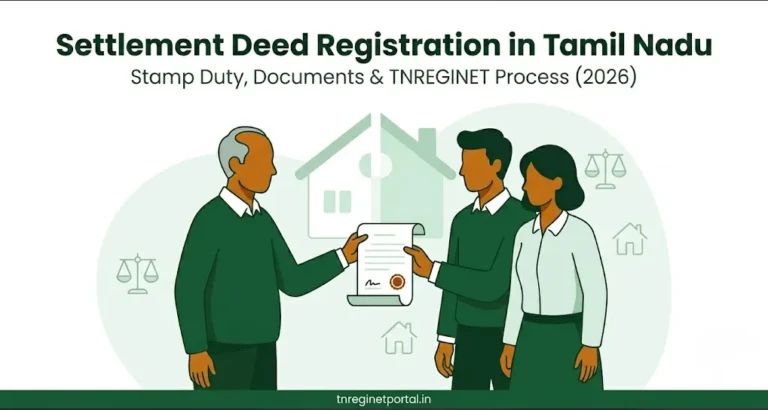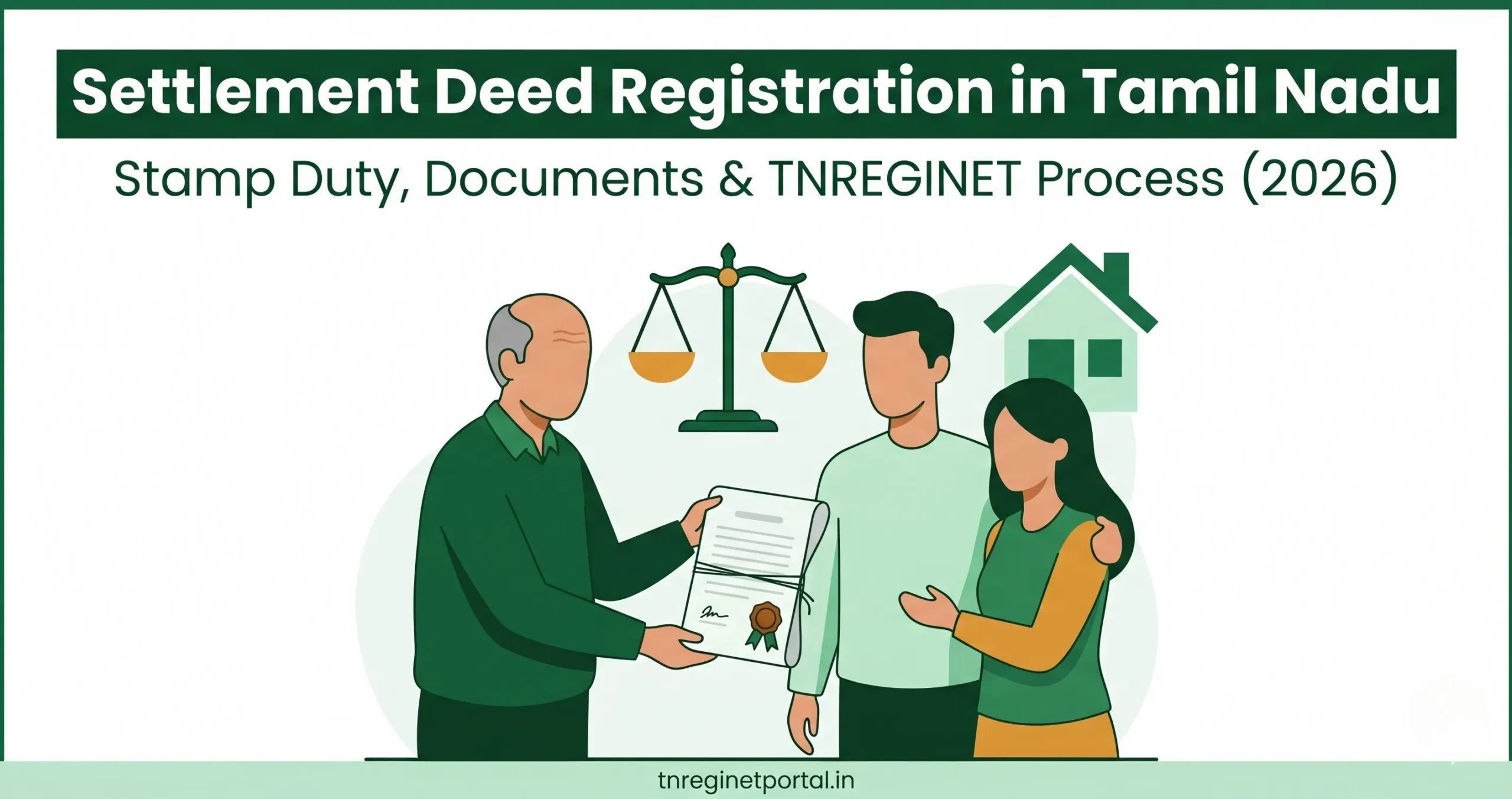
A settlement deed registration Tamil Nadu is the document most families actually need when transferring property to a spouse, child, parent, or sibling, yet most people reach for a Gift Deed instead and end up paying far more stamp duty than the law requires. This guide explains what a settlement deed is, who qualifies for the concessional rate, the documents you need, and the exact TNREGINET process to register one in 2026.
Family Transfers Only
Concessional Stamp Duty
Registration Mandatory
2026 Updated
What is a Settlement Deed Registration Tamil Nadu?
A settlement deed is a legal document through which a property owner transfers immovable property to one or more family members, usually to avoid future disputes or to formally divide assets while the owner is still alive. Like a gift, it involves no monetary consideration, but the Registration Department treats it as a distinct legal instrument from a Gift Deed, with its own eligibility rules and its own concessional fee structure. A settlement deed has no legal effect until it is registered at the Sub-Registrar Office where the property is situated.
Settlement Deed vs Gift Deed vs Release Deed: Why the Difference Matters
All three instruments transfer property without payment, which is exactly why people use the terms interchangeably and exactly why that habit is expensive. The Registration Department applies a different fee structure to each, and a Settlement Deed in favour of a defined family member is one of the cheapest ways to transfer property in Tamil Nadu, provided your situation actually qualifies.
⚡ Key takeaway: If you already have a Gift Deed drafted for a transfer to your spouse, child, parent, or sibling, ask your document writer or the Sub-Registrar whether a Settlement Deed applies instead, it is usually the cheaper route for that exact relationship. Exact eligibility depends on the relationship and ownership structure, so always confirm with the Sub-Registrar Office or a property lawyer before drafting the document, and verify the current applicable rate using the Stamp Duty Calculator before you proceed.
Stamp Duty and Registration Fee for Settlement Deeds in Tamil Nadu
The fee structure for a settlement deed depends entirely on whether the person receiving the property is a defined family member of the settlor. This is the single biggest cost lever in the entire process.
“Family member” for this concession is generally understood to cover spouse, children, parents, and siblings, but the precise eligible relationships and caps are notified by the government and can be revised. These figures are general guidance, not a substitute for the live calculation, so always confirm the exact applicable rate and your eligibility for the concession on the official Stamp Duty Calculator or with your Sub-Registrar Office before paying.
Documents Required for Settlement Deed Registration
- Original Settlement Deed Document — Drafted on non-judicial stamp paper, clearly stating the relationship between settlor and beneficiary and that the transfer is voluntary and without consideration.
- Proof of Ownership — Parent document, previous sale deed, or Patta Chitta showing the settlor is the legal owner.
- Proof of Relationship — Documents such as a ration card, family card, or birth/marriage certificate that establish the family relationship the concessional rate depends on.
- Encumbrance Certificate — Confirms the property is free from existing loans or legal disputes.
- Identity and Address Proof — Aadhaar Card, PAN Card, or Voter ID for both settlor and beneficiary.
- Passport-size Photographs — Recent photos of settlor, beneficiary, and witnesses.
- Property Tax Receipt and Guideline Value Certificate — Latest paid receipt, plus the guideline value used to calculate stamp duty if market value isn’t separately determined.
How to Register a Settlement Deed in Tamil Nadu via TNREGINET
Drafting needs a document writer or advocate, but the fee calculation, payment, and appointment booking can all be done online through TNREGINET before your Sub-Registrar Office visit.
Confirm Eligibility and Draft the Deed
Check with a document writer or the Sub-Registrar that your relationship qualifies for the family concession, then have the deed drafted with accurate property description and relationship details.
Calculate and Pay Stamp Duty Online
Use the TNREGINET Stamp Duty Calculator to confirm the exact concessional or standard amount, then pay through e-stamping (SHCIL) or the portal’s payment gateway.
Log In and Enter Document Details on TNREGINET
Log in at tnreginet.gov.in, select Document Registration, and enter settlor, beneficiary, property, and witness details exactly as they appear on the drafted deed.
Upload Documents and Book Your SRO Appointment
Upload scanned copies of all supporting documents, including proof of relationship, then select your Sub-Registrar Office and an available appointment slot.
Visit the SRO for Execution and Registration
Both settlor and beneficiary, along with two witnesses, must be present with original documents and identity proof. The Sub-Registrar verifies the deed and relationship proof, records biometrics, and registers the document. After registration, apply separately to transfer the Patta into the beneficiary’s name.
Related TNREGINET Services You May Need
- Gift Deed Registration Tamil Nadu — Compare this with a settlement deed if your beneficiary isn’t a defined family member.
- Stamp Duty Calculator Tamil Nadu — Calculate the exact stamp duty and registration fee for your settlement deed.
- Encumbrance Certificate Tamil Nadu — Verify the property is free of existing loans before settling it.
- Guideline Value Tamil Nadu — Check the government-fixed minimum value used to calculate stamp duty.
- Patta Transfer Tamil Nadu — Required next step to update land ownership records after registration.
Frequently Asked Questions
Conclusion
A settlement deed is often the cheapest legal way to keep property within the family in Tamil Nadu, but only if your relationship to the beneficiary actually qualifies for the concession, the gap between the family rate and the standard rate can run into lakhs. Confirm your eligibility and exact stamp duty liability through the official calculator before drafting anything, gather your Encumbrance Certificate, ownership proof, and relationship documents in advance, and remember to complete the Patta transfer after registration so your land records stay fully updated.