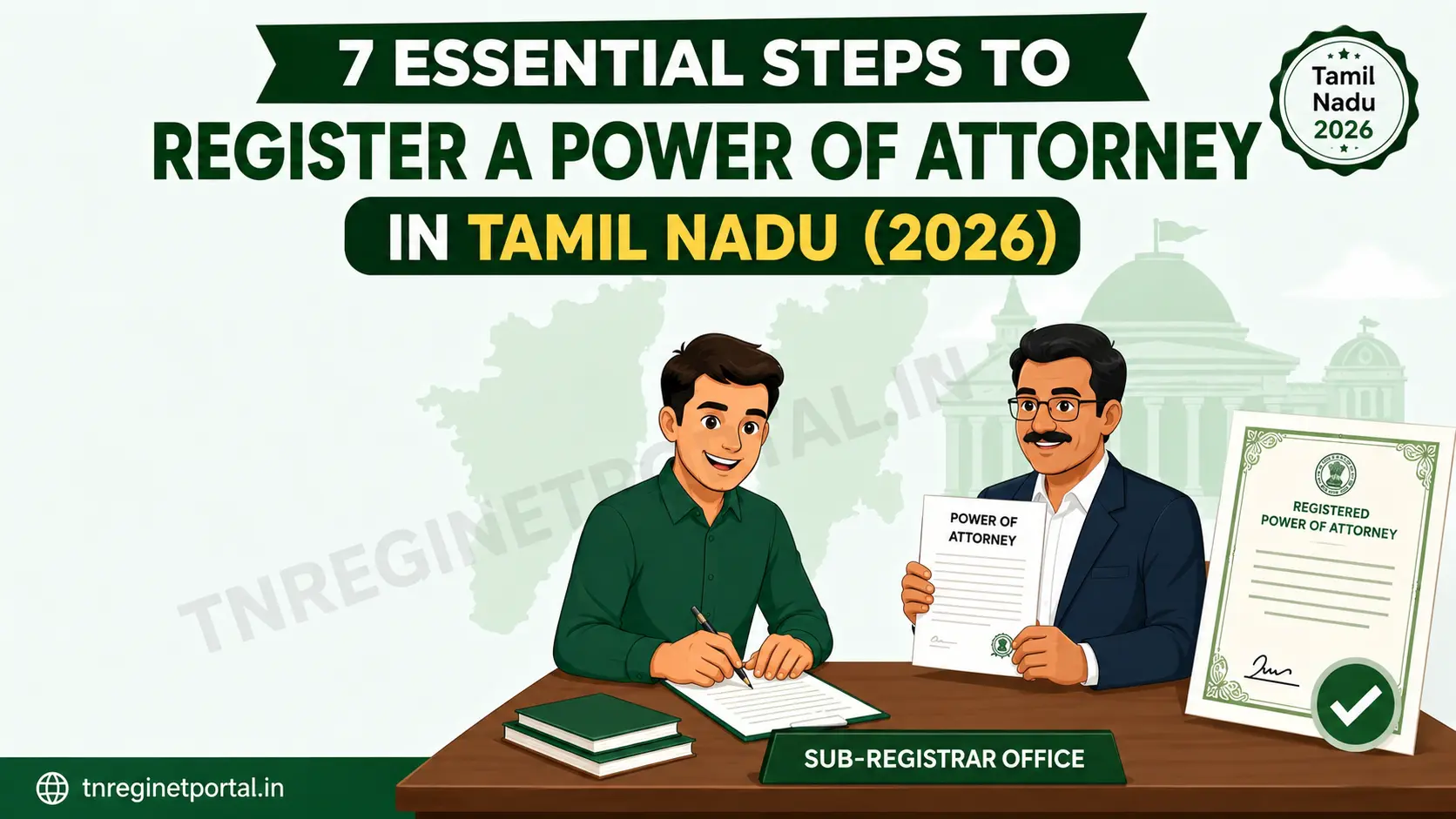
Power of attorney registration Tamil Nadu is mandatory the moment your POA touches immovable property, whether you are appointing a family member to sell your flat or an NRI child authorising a parent to handle a land deal back home. Skip registration, and the document has no legal weight at the Sub-Registrar Office. This guide covers POA types, current stamp duty, required documents, and the complete process, including the NRI route.
Mandatory Since Dec 2012
NRI Route Available
Life Certificate Rule
2026 Updated Fees
What Is a Power of Attorney in Tamil Nadu Property Transactions?
A Power of Attorney is a legal document through which a principal authorises an agent to act on their behalf in financial, legal, or property matters. Power of attorney registration Tamil Nadu becomes relevant whenever the principal cannot be physically present, commonly because they live abroad, are elderly, or are managing multiple properties across districts.
It is important to understand what a POA does not do. Granting a POA never transfers ownership of the property. The agent can sell, lease, or manage the asset on the principal’s behalf, but the actual transfer of title still requires a separate registered sale deed, gift deed, or settlement deed executed in the buyer’s or recipient’s name.
Since the Supreme Court’s ruling in Suraj Lamp and Industries versus State of Haryana, courts have been firm that a POA alone cannot convey ownership of immovable property. This makes proper power of attorney registration Tamil Nadu, followed by an actual registered deed, the only legally safe route for any property transaction handled through an agent.
General POA vs Special POA: Which One Do You Need?
Most people registering a power of attorney in Tamil Nadu choose between two types, and picking the right one affects both the agent’s scope and how the document is drafted.
⚡ Key takeaway: A POA never transfers ownership by itself. The agent must still complete a registered Sale Deed or Gift Deed in the buyer’s or recipient’s name for the transaction to be legally complete. Before relying on any POA-backed deal, always pull an Encumbrance Certificate on the property to confirm its legal status.
Stamp Duty and Registration Fee for POA Registration in Tamil Nadu (2026)
Power of attorney registration Tamil Nadu fees depend on whether the POA is given for consideration, meaning whether the agent pays the principal any money in exchange for the powers granted.
The exact registration fee cap for a non-consideration POA is the one figure worth confirming before you pay, since different published sources quote different ceiling amounts. Check the current figure under the Duty and Fees section on TNREGINET or ask the Sub-Registrar Office directly, since this is precisely the kind of detail that can change with government notifications.
Documents Required for Power of Attorney Registration
- Drafted POA Document: Printed on the correct stamp paper value, clearly stating the property details and the exact powers granted.
- Identity Proof: Aadhaar, PAN, passport, or voter ID for both the principal and the agent.
- Address Proof: A recent utility bill or equivalent document for both parties.
- Property Documents: Parent title deed and the latest property tax receipt, especially relevant alongside an Encumbrance Certificate check on the property.
- Passport Size Photographs: Recent photos of the principal, the agent, and both witnesses.
- Two Witnesses: Each carrying their own original identity proof for verification at the SRO.
- Life Certificate: Required for the principal if the POA involves a property transaction, issued by a registered medical practitioner or gazetted officer, valid for only 30 days.
Pro tip: The Life Certificate rule catches most families off guard. It confirms the principal is alive at the time of registration, and it must be dated close to your SRO appointment since it expires in 30 days. Plan this step last, right before your registration date, not weeks in advance.
How to Register a Power of Attorney in Tamil Nadu via TNREGINET
Power of attorney registration Tamil Nadu follows a process similar to other deeds, with a few extra checks specific to POAs.
Choose the POA Type and Draft It
Decide between a General or Special POA and have it drafted by an advocate, clearly stating the property description and the exact scope of the agent’s powers.
Calculate Stamp Duty Using TNREGINET
Use the Stamp Duty Calculator to confirm the exact duty applicable, based on whether your POA involves consideration.
Pay Stamp Duty and Registration Fee Online
Payment is made through TNREGINET’s e-payment gateway or e-stamping via SHCIL. Keep your receipt safely for the SRO appointment.
Book Your SRO Appointment
Schedule a slot at the Sub-Registrar Office within whose jurisdiction the property is located, or where the principal resides.
Obtain the Life Certificate
If the POA relates to a property transaction, get the principal’s Life Certificate issued close to your appointment date, since it is valid for only 30 days.
Attend the SRO Appointment
The agent must be present at the SRO with two witnesses. The principal need not be physically present if the POA was already attested abroad and forwarded properly.
Collect the Registered POA
After verification, the SRO retains a copy and returns the registered original. The agent can now act within the exact powers stated in the document.
Power of Attorney Registration for NRIs From Abroad
Power of attorney registration Tamil Nadu works a little differently when the principal lives outside India. A POA executed abroad for immovable property in Tamil Nadu does not require compulsory registration in the country of execution, but it must be attested by the Indian Embassy or Consulate there before it can be used.
Once attested, the NRI principal sends the original document to their agent in Tamil Nadu, typically by registered post or courier. The agent must then present it at the SRO within the specified timeframe, along with the postal cover, to get it adjudicated and registered before it can be used for any property transaction.
The principal does not need to be physically present in India for this registration, but the agent must attend in person. If multiple co-owners abroad are involved in the same property, each one needs to execute and attest their own separate POA rather than relying on a single joint document.
Related TNREGINET Services You May Need
- Encumbrance Certificate Tamil Nadu — Verify a property’s legal status before relying on any POA-backed transaction.
- Sale Deed Registration Tamil Nadu — The registered deed that must follow any POA-authorised property sale.
- Gift Deed Registration Tamil Nadu — Relevant when a POA agent is executing a family property transfer.
- Stamp Duty Calculator — Estimate your exact POA stamp duty before visiting the SRO.
Frequently Asked Questions
Conclusion
Power of attorney registration Tamil Nadu protects both the principal and the agent by giving the document real legal standing at the Sub-Registrar Office. Remember that a POA only delegates authority, it never transfers ownership by itself, so the actual sale, gift, or settlement deed must still follow. Keep the Life Certificate timing in mind if you are dealing with a property transaction, and NRI principals should attest their POA at the Indian Embassy before sending it home for registration.