A gift deed Registration Tamil Nadu lets you transfer property to a family member or anyone else without any money changing hands but in Tamil Nadu, the deed must still be registered, stamp duty must still be paid, and choosing the wrong type of deed can cost you far more than necessary. This guide walks you through the gift deed registration process in Tamil Nadu, the documents you’ll need, current stamp duty rates, and the one mistake that causes most families to overpay.
No Sale Consideration
Registration Mandatory
TNREGINET Online
2026 Updated
What is a Gift Deed Registration Tamil Nadu ?
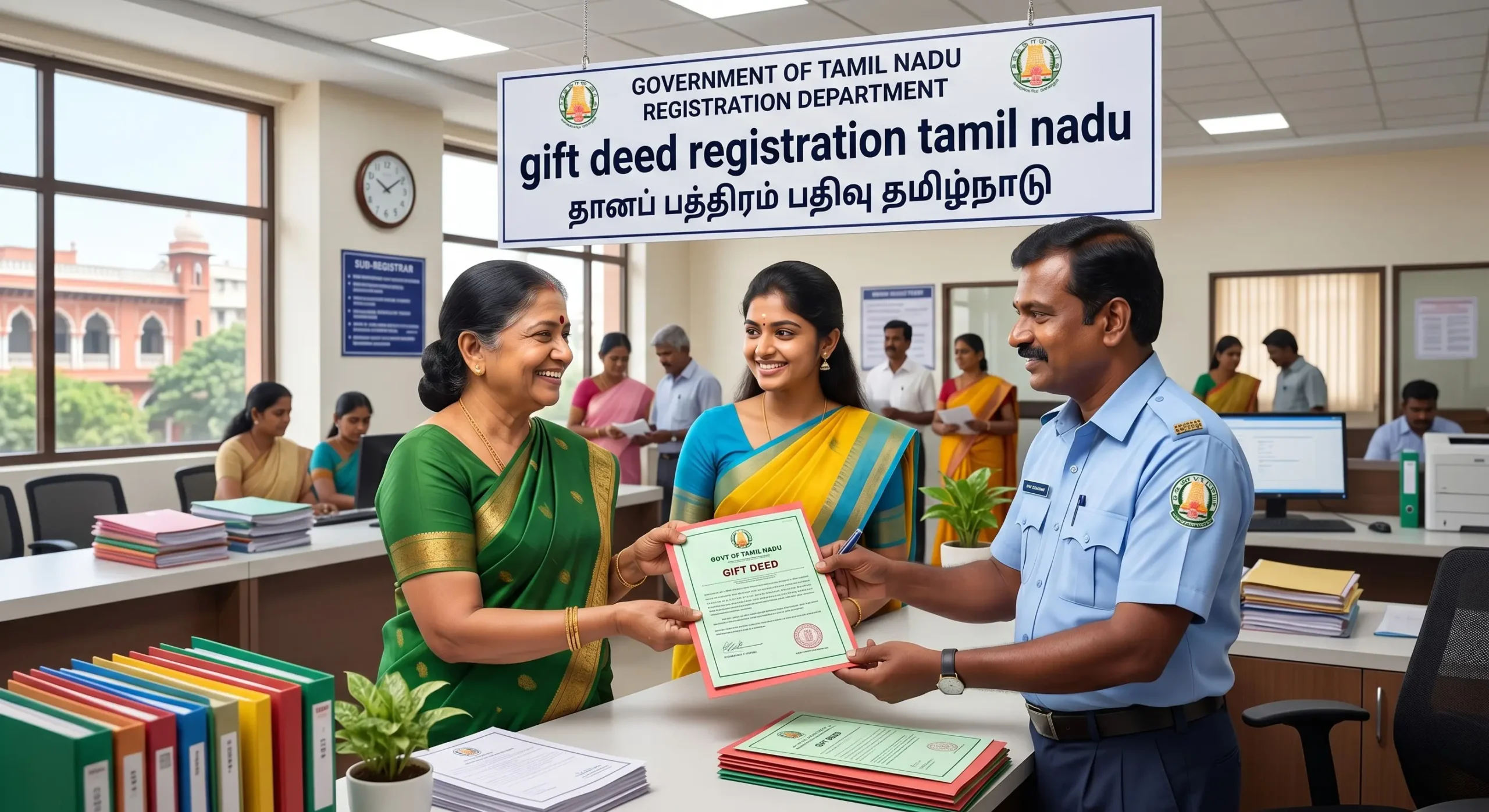
A gift deed is a legal document through which a property owner (the donor) voluntarily transfers ownership of immovable property to another person (the donee) out of love and affection, without receiving any payment in return. Unlike a sale deed, no money changes hands but the legal formalities are just as strict. An unregistered gift deed has no legal standing, and the transfer of ownership is not recognized until the deed is registered at the Sub-Registrar Office.
Gift Deed vs Settlement Deed vs Release Deed: The Mistake That Costs Families Lakhs
This is the single most misunderstood part of property transfer within families in Tamil Nadu. People often use the term “gift deed” loosely for any transfer to a relative, but the Registration Department treats Gift Deed, Settlement Deed, and Release Deed as three separate legal instruments and they are charged very differently. Picking the wrong one means paying full stamp duty when a concessional option was legally available.
⚡ Key takeaway: If you are transferring property to a spouse, child, parent, or sibling and there is no dispute over ownership, ask a document writer or sub-registrar whether a Settlement Deed or Release Deed applies to your situation instead of a Gift Deed. Exact eligibility depends on the relationship and ownership structure, so always confirm with the Sub-Registrar Office or a property lawyer before drafting the document and verify the current applicable rate using the Stamp Duty Calculator before you proceed.
Stamp Duty and Registration Fee for Gift Deeds in Tamil Nadu
A standard Gift Deed in Tamil Nadu attracts the same stamp duty and registration fee structure as a regular sale deed, calculated on the property’s market value or guideline value whichever is higher.
These percentages are revised periodically by government notification, and concessional treatment for specific family relationships can change. Always confirm the exact applicable rate on the official Stamp Duty Calculator before paying, since the figures above are general guidance and not a substitute for the live calculation.
Documents Required for Gift Deed Registration
- Original Gift Deed Document — Drafted on non-judicial stamp paper of the appropriate value, signed by the donor and accepted by the donee.
- Proof of Ownership — Parent document, previous sale deed, or Patta Chitta showing the donor is the legal owner.
- Encumbrance Certificate — Confirms the property is free from existing loans or legal disputes.
- Identity and Address Proof — Aadhaar Card, PAN Card, or Voter ID for both donor and donee.
- Passport-size Photographs — Recent photos of donor, donee, and witnesses.
- Property Tax Receipt — Latest paid receipt for the property being gifted.
- Guideline Value Certificate — Used to calculate the applicable stamp duty if the market value is not separately determined.
How to Register a Gift Deed in Tamil Nadu via TNREGINET
The drafting can be done with the help of a document writer or advocate, but the appointment booking, fee payment, and slot confirmation can all be completed online through TNREGINET before your Sub-Registrar Office visit.
Draft the Gift Deed
Engage a document writer or advocate to draft the deed with accurate property description, donor and donee details, and a clear statement that the transfer is voluntary and without consideration.
Calculate and Pay Stamp Duty Online
Use the TNREGINET Stamp Duty Calculator to determine the exact amount, then pay through e-stamping (SHCIL) or the portal’s online payment gateway.
Log In and Enter Document Details on TNREGINET
Log in at tnreginet.gov.in, select Document Registration, and enter donor, donee, property, and witness details exactly as they appear on the drafted deed.
Upload Documents and Book Your SRO Appointment
Upload scanned copies of all supporting documents, then select your Sub-Registrar Office and an available appointment slot.
Visit the SRO for Execution and Registration
Both donor and donee, along with two witnesses, must be present with original documents and identity proof. The Sub-Registrar verifies the deed, records biometrics, and registers the document. After registration, apply separately to transfer the Patta into the donee’s name.
Related TNREGINET Services You May Need
- Stamp Duty Calculator Tamil Nadu — Calculate the exact stamp duty and registration fee for your gift deed.
- Encumbrance Certificate Tamil Nadu — Verify the property is free of existing loans before gifting it.
- Guideline Value Tamil Nadu — Check the government-fixed minimum value used to calculate stamp duty.
- Property Registration Tamil Nadu — Full guide to the document registration process at the Sub-Registrar Office.
- Patta Transfer Tamil Nadu — Required next step to update land ownership records after registration.
Frequently Asked Questions
Conclusion
A gift deed is a straightforward way to pass on property within the family, but the cost difference between a Gift Deed, a Settlement Deed, and a Release Deed can run into lakhs of rupees depending on your specific situation. Before drafting any document, verify your exact stamp duty liability through the official calculator, gather your Encumbrance Certificate and ownership proof in advance, and remember to complete the Patta transfer after registration so your land records stay fully updated.