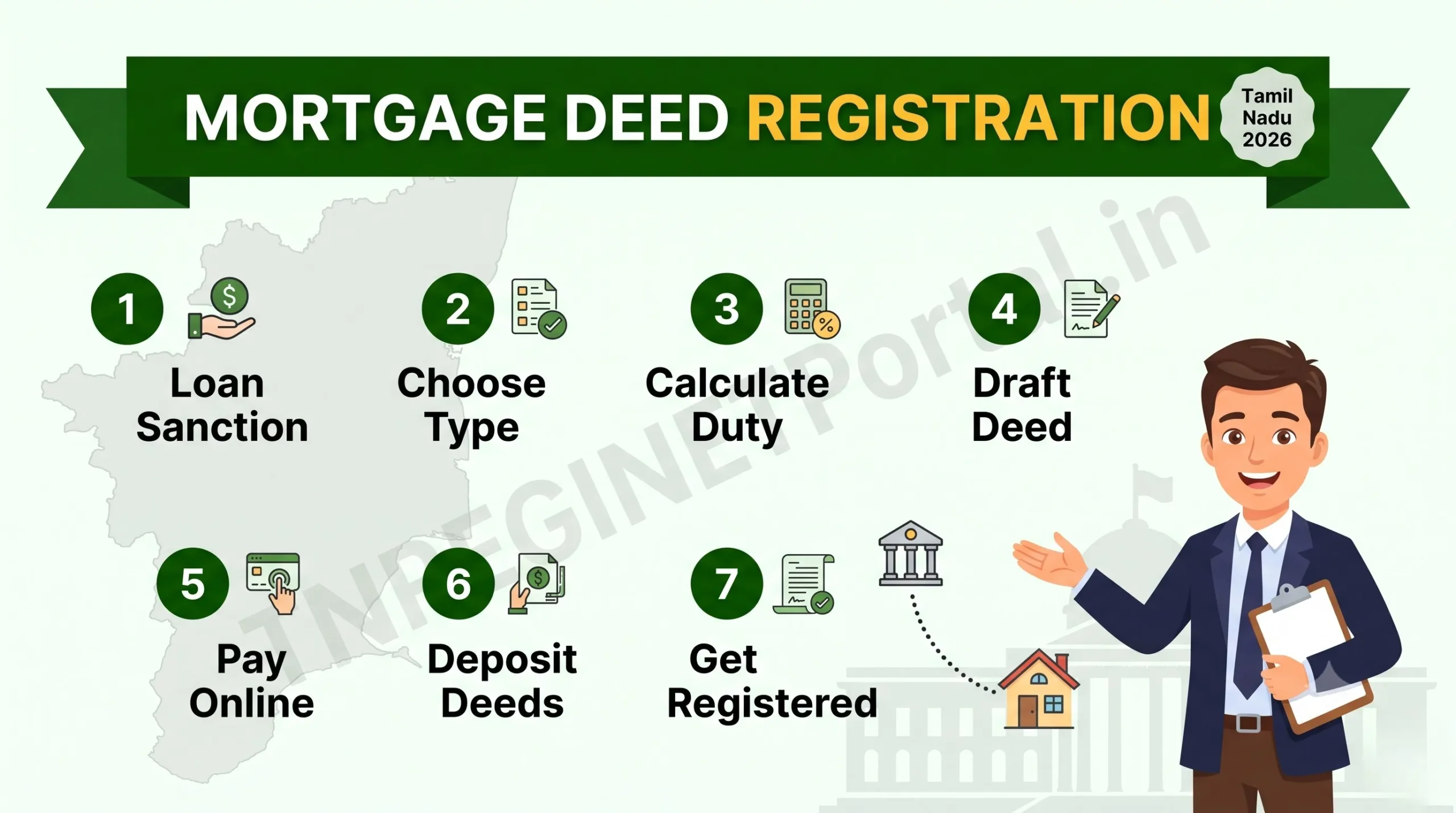
Mortgage deed registration Tamil Nadu is the legal step that puts your bank’s claim on your property on official record when you take a home loan or loan against property. Skip it, and your lender has no enforceable charge on the property even after disbursing the money. This guide covers the two mortgage types used in Tamil Nadu, current stamp duty, required documents, and the complete TNREGINET process.
Two Mortgage Types
Lower Duty Than Sale Deed
MODT Shows on EC
2026 Updated Rates
What Is a Mortgage Deed in Tamil Nadu?
A mortgage deed is the document that creates a legal charge on your property in favour of a bank or lender, in exchange for a loan. Unlike a sale deed, ownership does not transfer to the lender. You continue to live in and use the property; the lender simply gets a recorded right to recover the loan by selling the property if you default. Mortgage deed registration Tamil Nadu becomes relevant the moment you take a home loan, a loan against property, or any credit facility where your property is pledged as security.
Most banks in Tamil Nadu use one of two routes to secure a property-backed loan, and picking the right one matters because the cost and legal weight of each is quite different.
In practice, very few borrowers actually choose between the two. The bank’s credit policy decides it for you based on the loan amount, the loan product, and sometimes the property type. What you can control is making sure your documentation is ready before the file reaches the bank’s legal team, since a missing Patta or an unclear parent document is the single biggest reason mortgage registration gets delayed past the loan disbursement date buyers usually plan around.
Simple Mortgage vs MODT (Equitable Mortgage): What’s the Difference?
A Simple Mortgage involves a formal, fully drafted mortgage deed that is registered at the SRO like a sale deed. MODT (Memorandum of Deposit of Title Deeds), also called an equitable mortgage, is created simply by depositing your original title documents with the bank; in Tamil Nadu this deposit is still recorded at the SRO, which is a state-specific practice that makes the charge visible on public record even though the process is lighter than a Simple Mortgage.
⚡ Key takeaway: Whichever route your bank uses, the mortgage gets reflected on your property’s Encumbrance Certificate once registered, which is exactly how future buyers or new lenders find out a loan already exists on it. Before signing anything, cross-check the applicable guideline value for your property and confirm exact figures on the Stamp Duty Calculator.
Stamp Duty and Registration Fee for Mortgage Deed Registration in Tamil Nadu (2026)
Mortgage deed registration Tamil Nadu is charged very differently from a sale deed, since the duty is calculated on the loan amount instead of the property’s market value.
The exact rupee caps for MODT stamp duty and registration fee are the one figure worth double-checking before you pay, since different banks and published guides quote slightly different ceiling amounts. Ask your bank’s loan officer for the current cap, or check the “Duty and Fees” section after logging into TNREGINET, before finalising your payment. This mortgage deed stamp duty is paid separately from and in addition to whatever stamp duty was already paid on the original sale deed for the property.
Documents Required for Mortgage Deed Registration in Tamil Nadu
- Loan Sanction Letter: Issued by the bank confirming the loan amount, tenure, and terms.
- Original Title Deeds: The parent sale deed or previous ownership documents that will either be formally mortgaged or deposited with the bank.
- Encumbrance Certificate: Confirms the property is free of prior undisclosed claims; apply for your EC here before the bank processes the mortgage.
- Patta, Chitta and FMB Sketch: Revenue records confirming land classification, needed alongside your Patta Chitta for independent plots.
- Latest Property Tax Receipt: Shows no pending dues on the property being mortgaged.
- Bank-Appointed Valuation Report: The lender’s own valuer assesses the property before sanctioning the loan.
- Identity and Address Proof: Aadhaar, PAN, and a recent photograph of the borrower and co-borrower, if any.
- Draft MODT or Mortgage Deed: Prepared by the bank’s panel advocate, matching the loan sanction terms exactly.
Pro tip: Ask your bank’s loan officer for the exact list of documents their panel advocate needs at least a week before your planned disbursement date. Different banks sometimes ask for a slightly different set, for instance some insist on the last 30 years of parent documents while others accept 15, and finding this out early avoids a last-minute scramble.
How to Register a Mortgage Deed in Tamil Nadu via TNREGINET
The bank’s legal team drives most of this process, but knowing each step helps you spot delays early and keep your loan disbursement on schedule.
Loan Sanction and Property Valuation
Once your loan is sanctioned, the bank appoints a valuer to assess the property and its own legal team to verify the title chain and check the Encumbrance Certificate.
Choose the Mortgage Type With Your Bank
Most retail home loans default to MODT for its lower cost; large-ticket or non-standard loans sometimes require a Simple Mortgage instead. Your bank will confirm which applies.
Calculate Stamp Duty Using TNREGINET
Use the Stamp Duty Calculator to confirm the exact duty applicable to your loan amount and mortgage type before payment.
Draft the Mortgage Deed or MODT
The bank’s panel advocate prepares the deed or memorandum, matching the loan sanction letter’s amount, tenure, and property description exactly.
Pay Stamp Duty and Registration Fee Online
Payment is made through TNREGINET’s e-payment gateway or e-stamping via SHCIL. Banks often coordinate this step directly, but always keep your own copy of the receipt.
Deposit Title Deeds and Book Your SRO Appointment
For MODT, you hand over the original title deeds to the bank and the deposit is recorded at the SRO. For a Simple Mortgage, the full deed is registered like a sale deed, with an SRO appointment booked in advance.
Verification and Mortgage Record Update
Once registered, the mortgage appears on the property’s Encumbrance Certificate. Loan disbursement typically follows within a few working days of this step being completed.
Related TNREGINET Services You May Need
- Encumbrance Certificate Tamil Nadu — Check whether a property already carries a registered mortgage before you buy or lend against it.
- Stamp Duty Calculator — Estimate your exact mortgage deed stamp duty before visiting the bank.
- Guideline Value Check — Confirm the government value of your property before finalising the loan amount.
- Property Registration Tamil Nadu — The full sale deed process, required before any mortgage can be created on a fresh purchase.
- Gift Deed Registration Tamil Nadu — Relevant if the mortgaged property was originally acquired through a family gift.
Frequently Asked Questions
Conclusion
Mortgage deed registration Tamil Nadu is what actually gives your bank an enforceable claim on your property once a home loan is disbursed. Most borrowers will go through MODT since it costs less than a Simple Mortgage, but either way the charge needs to be registered at the SRO before your loan is fully processed. Keep your EC, title deeds, and property tax receipts ready in advance, confirm the exact stamp duty cap with your bank, and make sure the discharge is registered once the loan is closed.
