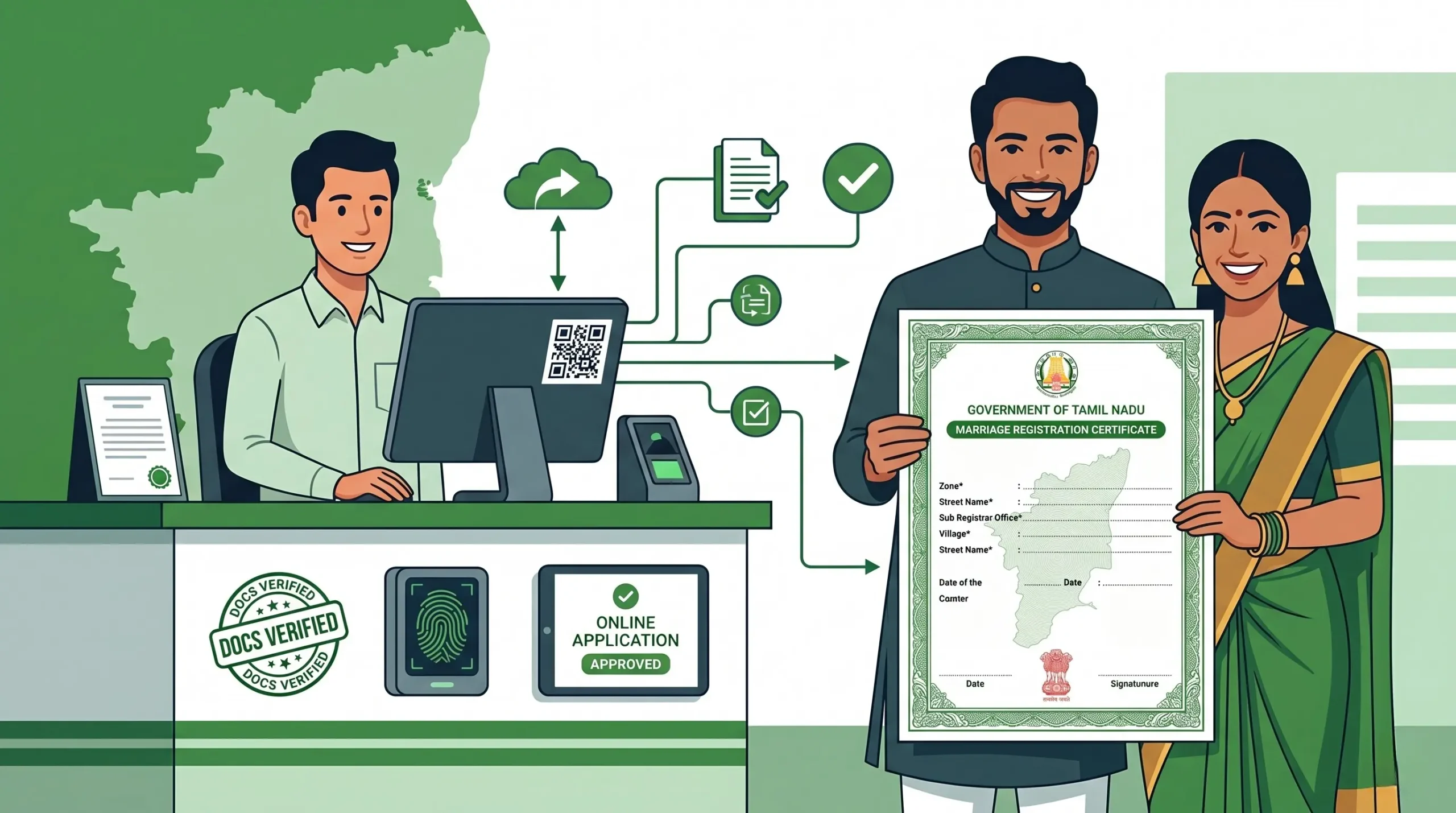
Getting married is one of the most significant events in a person’s life, and making it legally official protects both partners for years to come. In Tamil Nadu, the Tamil Nadu Compulsory Registration of Marriages Act, 2009 requires every couple to register their marriage, regardless of religion or community. The entire process, from initial application to certificate download, is handled through the official TNREGINET portal, managed by the Inspector General of Registration (IGRS).
Legal Proof
Online Process
All Religions
2026 Updated
Why Marriage Registration is Mandatory in Tamil Nadu
The Tamil Nadu Compulsory Registration of Marriages Act, 2009 made it legally binding for every couple who marries in the state to record their union with the government. This applies uniformly across all religions, castes, and communities. A registered marriage certificate is not merely a formality; it is a critical document required for several life events.
- Passport and Visa Applications — Required when applying for a spousal visa or adding a spouse to a passport, including NRI documentation.
- Banking and Insurance — Essential for opening joint accounts, nominee updates, and claiming spousal insurance benefits.
- Government Schemes and Benefits — Required for social security, pension claims, and government welfare scheme applications.
- Property and Inheritance Rights — Legally establishes spousal rights over jointly owned or inherited assets.
- Child Custody and Education — Necessary for birth certificates, school admissions, and custody proceedings.
Hindu Marriage Act vs Special Marriage Act: Which Applies to You?
Tamil Nadu recognizes two main legal routes for marriage registration through the TNREGINET portal. Choosing the right one depends on your religion, whether the ceremony has already taken place, and your timeline.
Hindu Marriage Act, 1955
- Who: Hindus, Sikhs, Buddhists, Jains
- Requirement: Marriage ceremony must have already been performed by a licensed priest
- Witnesses: 2 witnesses required
- Notice Period: None
- Government Fee: ₹100
- Processing Time: 7 to 15 working days after SRO appointment
Special Marriage Act, 1954
- Who: Interfaith, inter-caste, or civil marriages (open to all religions)
- Requirement: Marriage can be solemnized at the Registrar’s office itself
- Witnesses: 3 witnesses required
- Notice Period: Mandatory 30-day public notice
- Government Fee: ₹150
- Processing Time: 60 or more days from the date of notice filing
Eligibility Criteria for Marriage Registration Tamil Nadu
Before applying, confirm that both parties meet the following conditions set by the Registration Department.
- The bride must be at least 18 years of age and the groom at least 21 years of age at the time of the marriage.
- Both parties must give free and voluntary consent to the marriage without any coercion or undue influence.
- Neither party should have a living spouse at the time of registration.
- If previously married, the applicant must submit a valid divorce decree or the death certificate of the former spouse.
- Under the Hindu Marriage Act, the ceremony must have been performed by a licensed priest or authorized person, not merely at a temple.
Documents Required for Marriage Registration
Both the bride and groom must prepare scanned copies for online upload and original documents for physical verification at the Sub-Registrar Office on the appointment day.
Common Documents Required for Both Acts
- Age Proof — 10th Standard Marksheet, Birth Certificate, or Passport for both bride and groom
- Identity Proof — Aadhaar Card, PAN Card, Voter ID, or Passport
- Address Proof — Aadhaar Card, Ration Card, or recent Utility Bill
- Passport-size Photographs — 4 recent passport-size photos of both bride and groom
- Divorce or Death Certificate — Required only if either party was previously married
Additional Documents for Hindu Marriage Act
- Proof of Marriage Ceremony — Wedding invitation card, temple receipt, or marriage hall receipt confirming the ceremony date and venue
- Priest Certificate — A signed certificate from the licensed priest who performed the ceremony. Note that a general temple receipt alone is not sufficient; you specifically need the priest’s signed certificate.
Additional Documents for Special Marriage Act
- Affidavit of Marital Status and Consent — A sworn affidavit declaring free consent and confirming neither party has a living spouse
- Residence Proof for Notice Period — Document proving at least one partner has resided in the district for a minimum of 30 days before filing the notice
- NOC from Embassy — Required for NRI applicants, to be obtained from their respective embassy before application
How to Register Marriage Online via TNREGINET (Hindu Marriage Act)
This is the most common registration route in Tamil Nadu. The process is largely completed online, with one mandatory in-person visit to the Sub-Registrar Office for document verification and identity confirmation.
Log In to TNREGINET
Visit tnreginet.gov.in and log in with your registered username and password. If you do not have an account yet, you must first create a TNREGINET account under Registration and then User Registration. Account creation is completely free.
Navigate to Marriage Registration
From your dashboard, click on the Registration tab in the main navigation menu and select Marriage Registration. You will then be asked to choose your registration type. Select Hindu Marriage Act and proceed.
Fill in Bride and Groom Details
Enter the complete personal details of both the bride and groom: full name, date of birth, religion, father’s name, address, and contact information. You will also be required to enter the exact date and place where the marriage ceremony was conducted.
Enter Witness Details
Provide the names, addresses, and identity proof details of your 2 witnesses. Witnesses must be adults with valid government-issued ID and must be physically present at the Sub-Registrar Office on your appointment date.
Upload Required Documents
Upload clear scanned copies of all required documents: age proof, identity proof, address proof, wedding invitation or temple receipt, the priest’s signed certificate, and passport-size photographs of both parties. Documents should be in PDF or JPG format within the file size limits specified by the portal.
Pay the Registration Fee Online
Pay the government fee of Rs. 100 through the secure TNREGINET payment gateway. The portal accepts net banking, UPI, and debit or credit cards. A separate non-refundable online appointment booking fee of Rs. 100 is also collected at this stage.
Book Your Sub-Registrar Office Appointment
After payment, select your preferred Sub-Registrar Office and choose an available date and time slot. Save and print the acknowledgement slip generated by the portal. This slip carries your application number, which you will need for tracking and for your SRO visit.
Attend the SRO and Receive Certificate
On the appointed date, both bride and groom must be physically present at the SRO along with their 2 witnesses and all original documents. The Registrar will verify identities and documents. Once verification is successful, the marriage certificate is issued within 7 to 15 working days.
Special Marriage Act Registration: Key Differences
Couples registering under the Special Marriage Act follow the same online application flow through TNREGINET, but three important differences significantly affect the overall timeline and preparation required.
What Changes Under the Special Marriage Act
- 30-Day Public Notice Period: After filing the initial notice online or at the SRO, the Marriage Officer publishes it publicly for 30 days. This allows any person with a legal objection to come forward. The registration can only proceed after this period closes without a valid objection being raised.
- 3 Witnesses Required: Three adult witnesses with valid government-issued ID must be present at the Sub-Registrar Office on the day of registration, rather than two as required under the Hindu Marriage Act.
- Minimum Residency for Notice: At least one partner must have resided in the same district for a minimum of 30 days before the notice is filed. Proof of this residency is required at the time of application.
Marriage Registration Fees in Tamil Nadu
The government fees for marriage registration in Tamil Nadu are among the most affordable in the country. All payments are made securely through the TNREGINET online gateway before your appointment is confirmed.
Processing Time and Certificate Delivery
The time to receive your marriage certificate depends on which act you register under. Plan accordingly, especially if you need the certificate urgently for a visa or passport application.
Working Days
After SRO appointment (Hindu Marriage Act)
Days Minimum
From notice filing date (Special Marriage Act)
How to Download Your Marriage Certificate from TNREGINET
Once approved, you can download a digitally signed copy of your marriage certificate directly from the TNREGINET portal. Go to Certificate and then Marriage Certificate Download from the homepage menu.
Log in to your TNREGINET account at tnreginet.gov.in using your registered credentials.
Go to the Certificate section in the main menu and select Marriage Certificate Download.
Enter your registration number or application ID along with the date of marriage and both parties’ names to retrieve the record.
Download the digitally signed certificate as a PDF file. For purposes requiring apostille or embassy attestation, you will also need the physical copy from your Sub-Registrar Office.
Important: Register Within 90 Days to Avoid Penalties
Under the Tamil Nadu Compulsory Registration of Marriages Act, 2009, marriages must be registered within a fixed period of the ceremony date. Missing this window has serious consequences.
- 0 to 90 days after ceremony: Normal registration fee applies. No additional penalty.
- 90 to 150 days after ceremony: A late fee is charged at the SRO. Registration is still permitted.
- After 150 days: The Sub-Registrar can no longer process the registration. A court order may be required to legalize the marriage record.
Other TNREGINET Services You May Need
- Encumbrance Certificate Tamil Nadu — Verify that any property involved in post-marriage transactions is free from legal liabilities before transfer.
- Guideline Value Check Tamil Nadu — Find the government-fixed minimum land value for any locality before buying or selling property.
- Stamp Duty Calculator Tamil Nadu — Instantly calculate stamp duty and registration charges for any property transaction.
- Property Registration Tamil Nadu — Complete guide to registering a sale deed or property document at the Sub-Registrar Office.
Frequently Asked Questions
Conclusion
Registering your marriage through TNREGINET is straightforward once you know which act applies to your situation, what documents to prepare, and what timeline to plan for. Whether you are completing a Hindu Marriage Act registration in as little as 15 working days or planning ahead for the Special Marriage Act with its 30-day notice period, the TNREGINET portal gives you control over the entire process from home. Start early, keep all documents ready in scanned format, and register within 90 days of your ceremony to avoid late fees and complications.