Buying property in Tamil Nadu means budgeting for more than the price you agree with the seller. Two government charges sit on top of that price: stamp duty and a registration fee. For a standard sale deed they add up to about 11% of the property value, which is why planning for them early saves you an unpleasant surprise at the Sub-Registrar Office. This guide explains the 2026 rates, how the charges are calculated, the concession for women buyers, and the documents you will need.
How the Tamil Nadu Land Registration Fees Calculator Works
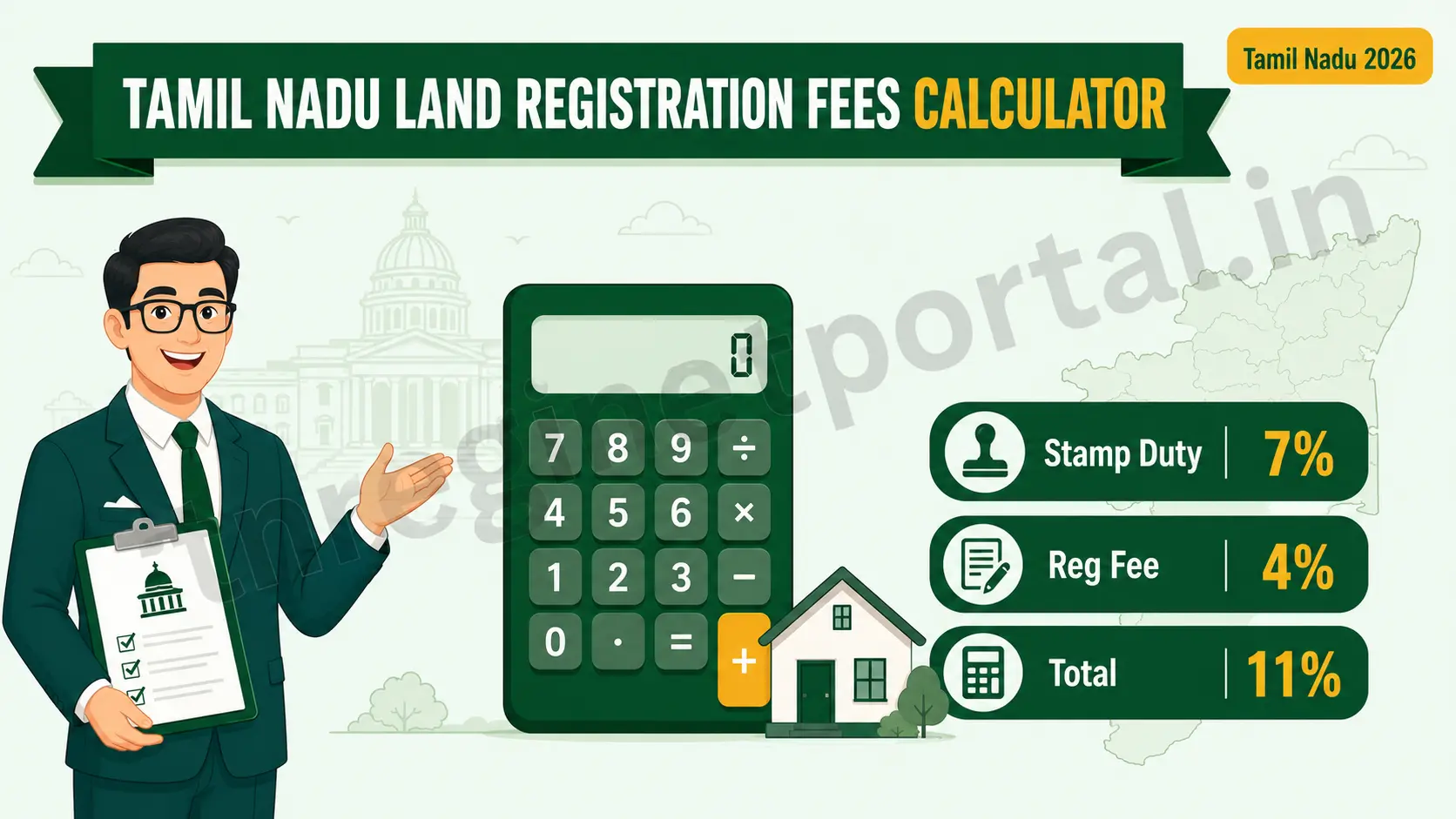
When you register property in Tamil Nadu, two separate government charges apply: stamp duty and a registration fee. The Tamil Nadu Land Registration Fees Calculator helps you estimate these costs based on the property value and applicable rates. For a standard sale deed, stamp duty is 7% of the property value and the registration fee is 4%, so most buyers should plan for roughly 11% of the property value on top of the purchase price.
Stamp duty is a tax on the document that records the transfer of ownership, usually the sale deed. It matters because a deed that is not properly stamped has very weak legal standing, and courts generally will not accept an under-stamped document as evidence in a property dispute. The registration fee is a separate charge for formally recording that deed in the government’s land records, which is what puts your name on the official register and lets you use the property later for resale, a loan, or inheritance.
Rates by deed type (2026)
Stamp duty in Tamil Nadu is not a single flat rate. It depends on the type of deed and, for some deeds, on whether the transaction is between family members. The table below shows the common rates.
| Deed type | Stamp duty | Registration fee |
|---|---|---|
| Sale / Conveyance | 7% | 4% |
| Gift (non-family) | 7% | 4% |
| Gift (family) | 7% | 4% |
| Settlement / Release / Partition (family) | 1% (max ₹25,000) | 1% (max ₹4,000) |
| Release (non-family) | 7% | 1% |
| Mortgage (with possession) | 4% | 1% (max ₹10,000) |
Concession for women buyers
From 1 April 2025, a woman registering a sale property valued up to ₹10 lakh pays a 3% registration fee instead of the usual 4%. The stamp duty stays the same. The concession applies only to a sale deed at or below ₹10 lakh. Above that value, or for other deed types, the standard rate returns. For a large share of registrations that fall in this bracket, this small change makes property ownership a little more affordable for women.
A worked example
Say you buy a flat in Chennai for ₹60,00,000, and the guideline value for that street is ₹55,00,000. Charges apply on the higher figure, which is your sale value of ₹60,00,000. Stamp duty at 7% works out to ₹4,20,000, and the registration fee at 4% is ₹2,40,000. Your total statutory cost is ₹6,60,000, which sits on top of the ₹60,00,000 purchase price. That single number is why buyers who plan for it early avoid a nasty surprise on registration day.
Now flip the example. If the same flat had a sale price of ₹50,00,000 but a guideline value of ₹55,00,000, you would pay on ₹55,00,000, because the guideline value is higher. This is the most common reason a buyer’s actual bill comes out higher than they first expected, so it is worth checking the guideline value before you finalise anything.
Mistakes that quietly raise your cost
A few avoidable errors catch first-time buyers. Ignoring the guideline value and budgeting only on the sale price is the biggest one, since the higher of the two always wins. Overlooking the small stamp duty on the agreement to sell is another, because some buyers assume only the final sale deed is chargeable. Assuming the women concession applies to any property is a third, when in fact it is limited to a sale deed up to ₹10 lakh. And forgetting that TDS may apply separately, at 1% of the sale value where the property is above ₹50 lakh under the Income Tax Act, can throw off your total outflow even though it is not part of stamp duty itself.
Documents you will need at registration
Before you visit the Sub-Registrar Office, keep the original sale deed or applicable deed ready, along with the parent documents that establish the chain of ownership. You will also want a recent encumbrance certificate confirming the property carries no pending loans or dues, the patta or chitta for plots and land, and identity and address proof for the buyer, seller and witnesses. If the property is above ₹50 lakh, carry the TDS payment receipt as well. Having these in order keeps the registration itself quick once your stamp duty and fee are paid.
How to pay stamp duty and registration fees
You can pay online or offline. Online, the charges are paid securely through the official state portal before your appointment, which most buyers now prefer. Offline, payment is accepted at authorised banks and collection centres, and stamp duty can also be paid through e-stamping. Whichever route you choose, keep the e-payment receipt, because you will need it at the Sub-Registrar Office on the day of registration. Once the charges are paid and your documents are verified, the deed is registered and the property record is updated in your name.
Check guideline value: find the government minimum value for your street before you estimate.
View EC online: confirm the property has no pending loans or dues before you register.
TNREGINET login & registration: create your account to start the registration process.
In short
For a normal sale in Tamil Nadu, budget about 11% of the property value for stamp duty and registration together, calculated on whichever is higher between your sale price and the guideline value. Check your guideline value first, keep your documents ready, and confirm the exact figures for your deed on the official TNREGINET portal before you register at the Sub-Registrar Office.