Before you buy property anywhere in Chennai, one number decides your minimum stamp duty and registration cost: the guideline value Chennai. It changes street by street, and getting it wrong is what leads to under-budgeting or a registration surprise. This guide shows you exactly how to find the official guideline value for your Chennai street, and, just as importantly, how it differs from the market price agents quote you.
In this guide:
What Guideline Value Chennai Means
The guideline value, also called the circle rate or government value, is the minimum price per square foot (or per square metre) that the Tamil Nadu government fixes for a specific location. You cannot register a property below this value. It exists to stop under-reporting of property prices and to fix a fair base for calculating stamp duty and registration charges.
Two things make Chennai different from the rest of Tamil Nadu. First, it has the widest spread of values in the state, from modest rates in outer areas to some of the highest rates in Tamil Nadu in prime central pockets. Second, Chennai has the largest number of individually-rated streets, so the value can change sharply from one street to the next within the same neighbourhood. That is why a single “Chennai rate” does not exist, and why you must check your exact street rather than rely on an area average.
Guideline Value vs Market Value: Clear Up This First
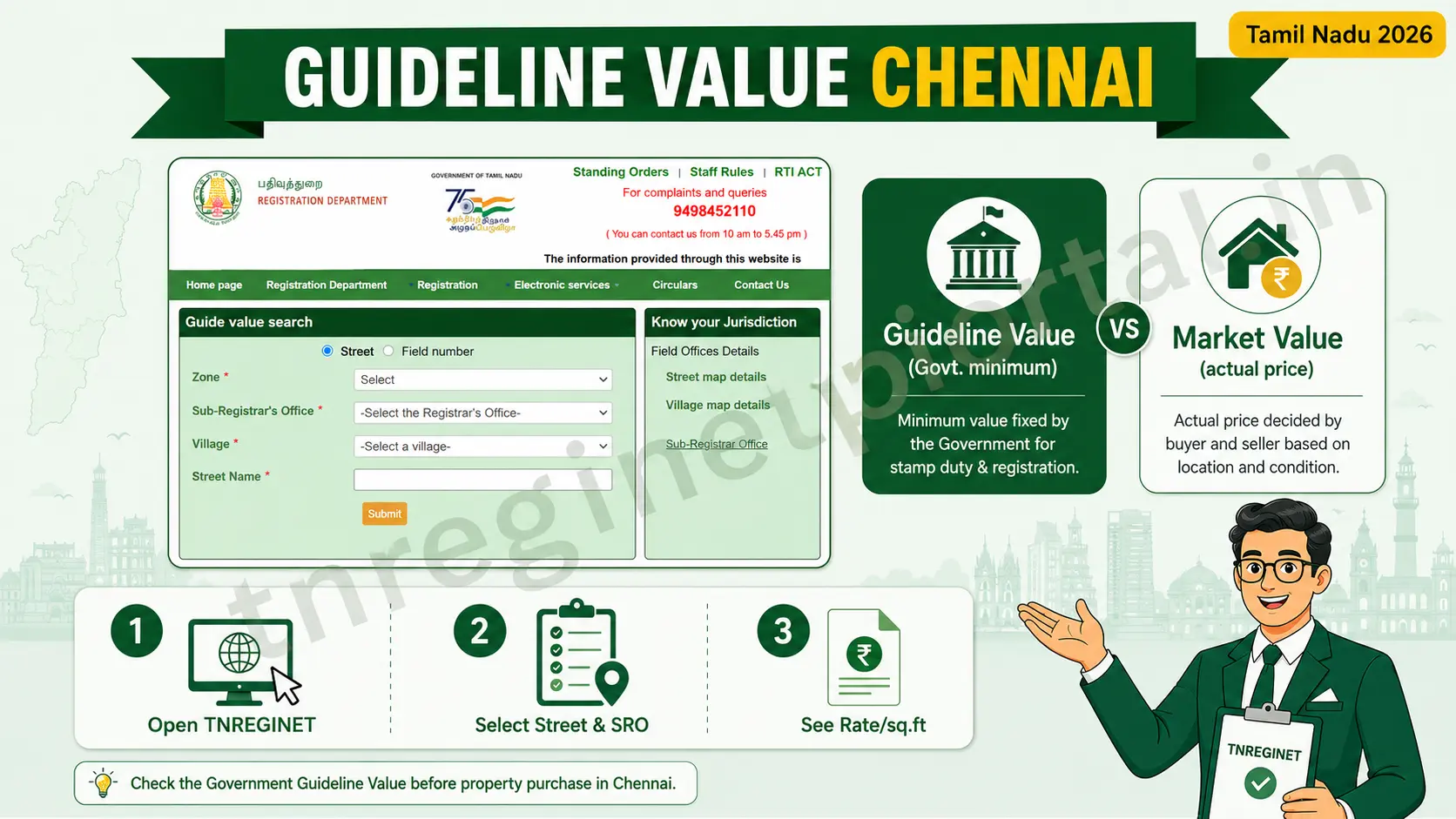
This is where most buyers get misled. Many websites and agents quote a “guideline value” for areas like Anna Nagar or T. Nagar that is actually the market rate, and the two are very different numbers. Confusing them can throw your entire budget off.
| Guideline value | Market value | |
|---|---|---|
| Who sets it | Tamil Nadu government (Registration Dept.) | Buyers, sellers and demand |
| What it is | Legal minimum for registration | Actual price a property sells for |
| Which is higher | Usually the lower of the two | Usually higher than guideline value |
| Where to find it | Only tnreginet.gov.in (official) | Property portals, agents, recent deals |
The practical takeaway: when someone quotes you a “rate per sq.ft” for a Chennai locality, ask whether it is the guideline value or the market rate. For stamp duty, only the official guideline value from the portal matters, and it is charged on whichever is higher, the guideline value or your actual sale price.
How to Check Your Chennai Street’s Guideline Value
The whole point is to get the exact value for your street, not an area guess. Here is the current process on the official portal.
Getting the Zone and SRO Right
Guideline values are SRO-specific, so selecting the wrong Sub-Registrar Office is the fastest way to get a wrong figure. Chennai spans multiple zones and many SROs, covering localities such as Anna Nagar, Adyar, T. Nagar, Velachery, Ambattur, Avadi, Porur, Vadapalani and many more, each mapped to a particular SRO.
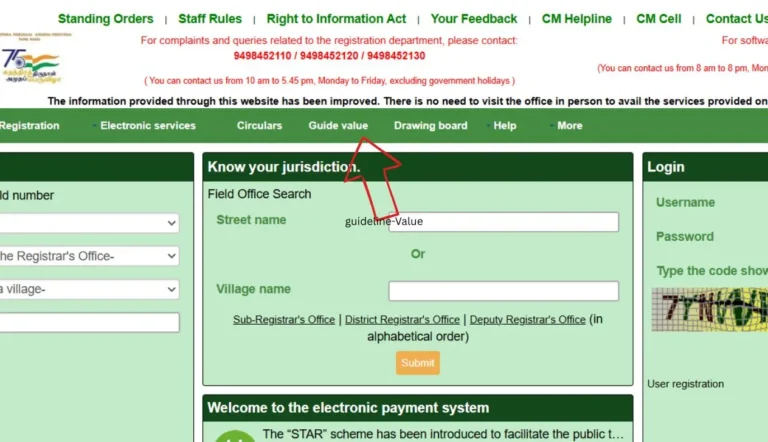
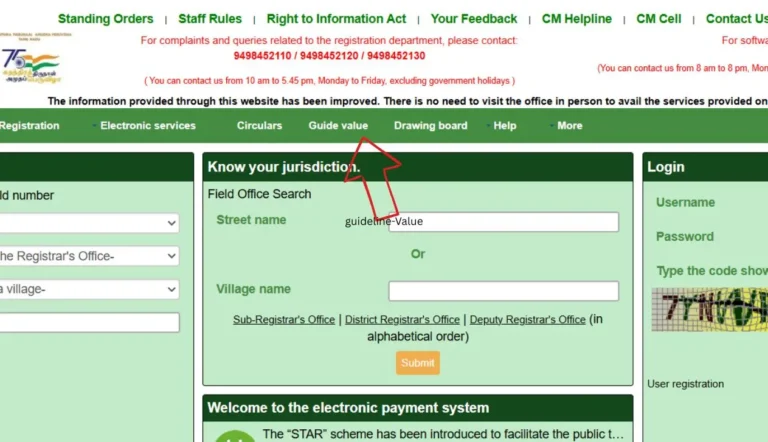
If you are not sure which SRO your property falls under, use the portal’s “Know Your Jurisdiction” tool: enter your street or village name and it will tell you the correct district, zone and SRO. Getting this right first means your guideline value search returns the correct street the first time. Our separate guide to finding your survey number online is handy if you plan to search by survey number instead of street.
Buying an Apartment? Check the Composite Value
For flats and apartments, Tamil Nadu increasingly uses a Composite Value system rather than a plain land rate, since an apartment’s value combines the undivided share of land and the built-up portion. On the guideline value page, look for the Composite Value option and search village-wise for your project’s location. If you are unsure whether your flat falls under composite valuation, confirm with the concerned SRO before you finalise your budget, because it changes how the minimum registration value is worked out.
How Guideline Value Decides Your Stamp Duty
Stamp duty and registration charges in Tamil Nadu are calculated on the higher of your actual sale price or the guideline value. So even if you negotiate a price below the guideline value, your duty is still charged on the guideline value.
Simple example: Say a 1,000 sq.ft property has a guideline value of a certain rate per sq.ft. Multiply that rate by 1,000 to get the minimum registration value. Stamp duty and registration are then charged on that figure (or on your sale price, whichever is higher). To turn your specific numbers into an actual rupee estimate, use our Tamil Nadu stamp duty calculator.
Common Mistakes to Avoid
- Using an area average instead of the exact street. Values differ street to street; an “Anna Nagar rate” is meaningless for registration.
- Mistaking market rate for guideline value. The two are different numbers; only the portal figure applies to stamp duty.
- Picking the wrong SRO. Values are SRO-specific; verify jurisdiction first.
- Reading an old date range. Always select “From 01-07-2024” for current values.
- Not re-checking before registration. Values can be revised; confirm again close to your registration date.
For agricultural land, it is also worth confirming with the Village Administrative Officer (VAO), as local reclassifications sometimes lag behind the online record. Before any purchase, pair your guideline value check with an Encumbrance Certificate check to confirm the property is free of loans or disputes.
Frequently Asked Questions
Is checking guideline value in Chennai free?
Yes. Checking guideline value on TNREGINET is completely free and needs no login. You can look up any street or survey number in Chennai without paying a fee.
What is the guideline value for Chennai in 2026?
There is no single Chennai figure. Values vary street by street, with prime central roads far higher than outer areas. Check the exact value for your specific street on the TNREGINET portal, as that is the only figure valid for registration.
Is guideline value the same as market value?
No. Guideline value is the government-set legal minimum for registration; market value is what the property actually sells for and is usually higher. Only the guideline value from the portal is used for stamp duty.
Can I register a property below the guideline value in Chennai?
No. Property must be registered at the guideline value or the actual sale value, whichever is higher. Stamp duty is charged on that higher figure.
How often is the guideline value updated?
The Tamil Nadu government revises guideline values periodically, not every year. The most recent state-wide revision took effect on 1 July 2024. New rates appear on the portal as soon as they are notified.
Which portal shows the official Chennai guideline value?
Only the official TNREGINET portal at tnreginet.gov.in shows the official guideline value. Rates on property websites are usually market estimates, not the government registration value.
In Short: Your Next Step
Don’t rely on an area average or a market rate. Go to tnreginet.gov.in, open Guideline Value, select “From 01-07-2024”, set the correct Zone and SRO, and search your exact street to get the official figure. Use that number (or your sale price, whichever is higher) with our stamp duty calculator to budget accurately, and re-check the portal close to your registration date since values can be revised.
Related Services
- Guideline Value Check Tamil Nadu — the full state-wide guide to checking values in any district.
- Stamp Duty Calculator Tamil Nadu — turn your guideline value into an actual cost estimate.
- Encumbrance Certificate Tamil Nadu — verify a property is free of loans before you buy.
- Find Survey Number Online — locate the survey number to search by land instead of street.
Last updated: July 2026. This is an independent guide and is not affiliated with the Government of Tamil Nadu. Guideline values, stamp duty rates and portal features can change, so always confirm the current figures for your exact street on the official portal tnreginet.gov.in before any transaction.